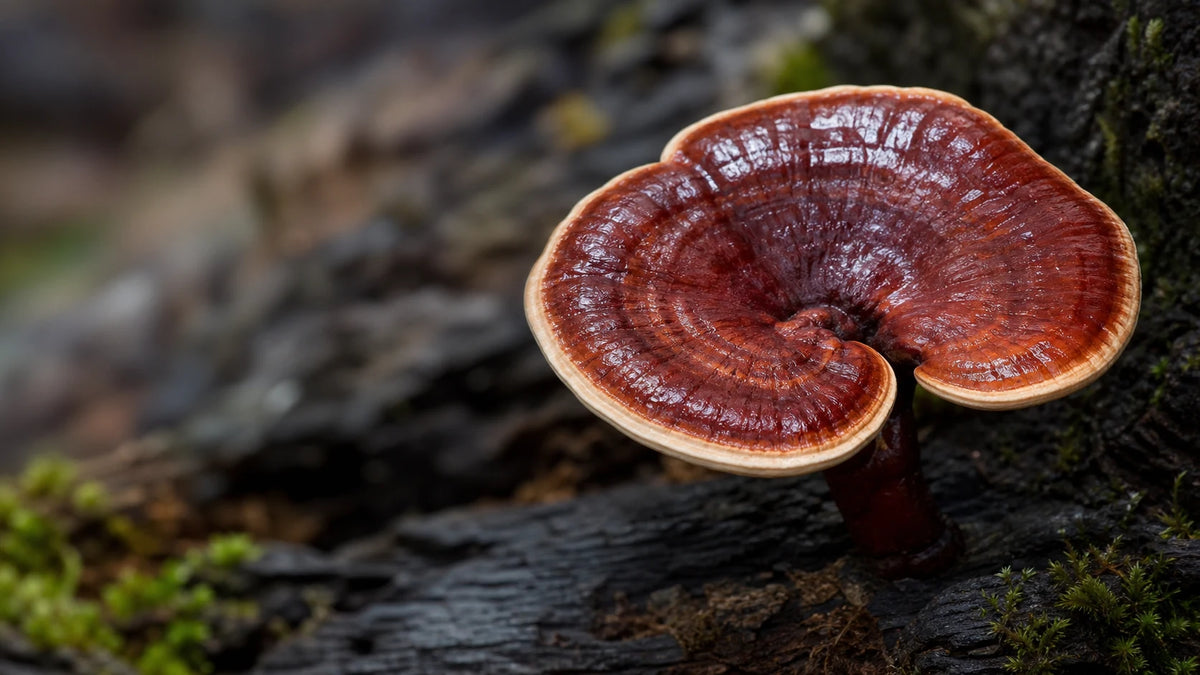


- Reishi is the common name for Ganoderma lucidum, a fungal ingredient studied mainly through polysaccharides, beta-glucans, and triterpenes.
- Human Reishi studies exist, but the evidence is mixed and often uses specific extracts, not consumer products as a category.
- Stress-response claims need caution. Reishi is studied in stress biology, but direct human cortisol evidence is limited.
- WAVE uses Reishi as one ingredient in a nicotine-free, caffeine-free pouch format.
Reishi is the common name for Ganoderma lucidum, a fungus studied for compounds such as polysaccharides, beta-glucans, and triterpenes. In supplement conversations, people usually ask about Reishi effects. The better question is narrower: what has research actually investigated?
Beta-glucans are structural polysaccharides found in fungal cell walls. Triterpenes are another class of compounds isolated from Ganoderma lucidum. Neither word means a product can promise stress relief, immunity, or mental performance. It means the ingredient has a research trail you can read.
What is Reishi, and why do people search for its effects?
Reishi is a functional fungal ingredient with a long history of use and a modern research record focused on extracts, immune markers, oxidative stress models, and quality-of-life endpoints.
The scientific name matters because "Reishi" can point to different raw materials, extract types, and production methods. A paper on a purified polysaccharide extract is not the same thing as a finished pouch, capsule, powder, or tea. That distinction sounds boring until you're comparing products on the shelf.
A clinical trial on a Ganoderma lucidum polysaccharide extract, often called Ganopoly in the paper, studied safety and selected immune parameters in adults with advanced cancer (Gao et al., 2005). That kind of paper is useful for understanding how researchers frame Reishi extracts. It does not support a general claim that Reishi improves immunity in healthy users.
For WAVE, the cleaner way to read Reishi is ingredient-first. The product is a food supplement. Each pouch has a defined formula, and the ingredient language stays factual: nicotine free, caffeine free, sugar free, with Reishi included as part of the composition. You can see the format here: WAVE functional pouches.
What does the research say about Reishi and stress response?
Reishi is studied in stress-response biology, but current public evidence does not justify a broad human claim that Reishi reduces stress or cortisol.
This is where supplement writing often gets loose. Stress is a human experience. Cortisol is a measurable hormone. A cell study, an animal model, and a human trial answer different questions. They don't collapse into one simple sentence.
One recent laboratory paper looked at Ganoderma lucidum extract in a corticotropin-releasing hormone stress-response model related to follicular cells (Cheng et al., 2024). That is mechanistic research. It can help scientists ask better questions about stress biology, but it can't be turned into a consumer promise.
A separate human trial tested a blend containing both Ganoderma lucidum and Ophiocordyceps sinensis in endurance athletes (Rossi et al., 2014). Because the trial used a combination, it can't isolate Reishi as the active driver of any measured outcome. Good research still has boundaries.

What are beta-glucans in Reishi?
Beta-glucans are polysaccharides in fungal cell walls, and Reishi research often studies them as isolated compounds or as part of broader polysaccharide extracts.
In 2022, a study on Reishi beta-1,3/1,6-glucan examined immune markers in healthy adults (Rahar et al., 2022). The useful takeaway is modest: beta-glucan research can measure immune-related markers. The article does not give every Reishi product permission to claim immune support.
EFSA has also reviewed beta-glucans in other contexts. A 2011 EFSA opinion assessed yeast beta-glucans as a novel food ingredient and considered safety under specified uses (EFSA Opinion 2011). Safety review and health-claim approval are different things. That difference is why WAVE talks about composition and research, then keeps product claims narrow.
| Research area | What it can tell you | What it cannot prove |
|---|---|---|
| Polysaccharide extracts | How a defined extract behaves in a specific study design | That all Reishi products share the same effect |
| Beta-glucans | How selected immune markers respond in controlled settings | A broad immune claim for a finished food supplement |
| Stress biology | How models of stress response are built and measured | That Reishi lowers stress in daily life |
How should you read Reishi supplement labels?
A useful Reishi label tells you the species, part used, fruiting body source, extract type, and dose per serving.
Start with the Latin name. Then check whether the brand lists a dose for Reishi or hides it inside a generic blend. WAVE lists the formula plainly and uses a pouch format designed for adults who want a nicotine-free, caffeine-free ritual with defined ingredients. The product page is here: WAVE Natural mushroom pouches.
Fruit body sourcing and extraction method also matter. A fruiting body extract is not identical to mycelium grown on grain, and a hot-water extract is not the same as a dual extract. These details affect what ends up in the raw ingredient. They still don't create a health claim by themselves.
For mental-function language, WAVE anchors the claim to Vitamin B12, because that is where the approved wording exists. Vitamin B12 contributes to normal psychological function. Vitamin B12 contributes to the reduction of tiredness and fatigue. Vitamin B12 contributes to normal energy-yielding metabolism. Vitamin B12 contributes to the normal functioning of the nervous system.
Where does Reishi fit inside WAVE?
Reishi is one part of the WAVE formula, alongside other defined ingredients in a pouch format with no nicotine, no caffeine, and no sugar.
That format matters for habit and context. Some people like capsules. Some prefer powders. WAVE is built for adults who already understand the oral pouch format and want a food supplement version with a cleaner ingredient story. The format can sit in a workday without caffeine or nicotine. It should still be read as a food supplement, not a shortcut to a physiological outcome.
If you want the simplest product-level reading, use this: Reishi is a researched ingredient in the formula. Vitamin B12 carries the approved health-claim wording. The pouch format carries the daily ritual. Those are separate facts, and they should stay separate.
You can review the current product here: WAVE nicotine-free pouches.
Frequently asked questions
Does Reishi reduce stress?
Current research does not justify a broad consumer claim that Reishi reduces stress. Some studies investigate stress-response biology, but that is not the same as a proven daily-life effect.
What compounds in Reishi are studied most often?
Reishi research often focuses on polysaccharides, beta-glucans, and triterpenes. Study results depend on the exact extract, dose, and population.
Is Reishi the ingredient behind WAVE's mental-function wording?
No. WAVE uses exact approved wording for Vitamin B12: Vitamin B12 contributes to normal psychological function.
Does WAVE contain nicotine or caffeine?
No. WAVE is nicotine free and caffeine free. It is a food supplement in pouch form.
Food supplement. Not a substitute for a varied, balanced diet and a healthy lifestyle. WAVE is not a nicotine replacement therapy nor a means of quitting addictive substances. Do not exceed the recommended daily dose (max 6 pouches / 24 hours). Keep out of reach of children. Not suitable for pregnant or breastfeeding women. Product does not contain psilocybin or other psychoactive substances. Distributor: Geim s.r.o., Příkop 843/4, 602 00 Brno · DIČ: CZ06169457